Ultrasound-Activated Microbubbles Deliver OPROTACs Directly Into Cancer Cells
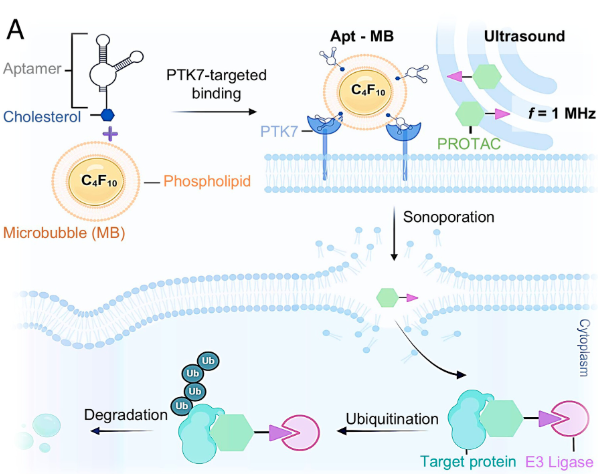
Duke researchers developed a new drug-delivery technology that uses cancer-targeting microbubbles and ultrasound to help large therapeutic molecules enter tumor cells. Called Sonoporation-assisted Precise Intracellular Nanodelivery (SonoPIN), the approach delivered PROTAC protein degraders into targeted cancer cells while largely sparing non-targeted cells. In laboratory experiments, SonoPIN caused about half of the targeted cancer cells to die while 99% of non-targeted cells remained viable.
PROTACs work by recruiting the cell’s protein-disposal machinery to destroy specific disease-causing proteins, but their relatively large molecular size can make efficient intracellular delivery difficult. SonoPIN addresses this problem mechanically: cancer-targeting microbubbles attach to the cell surface and are activated by ultrasound, creating temporary nanoscale openings in the cell membrane. These pores allow PROTAC molecules to enter before the membrane rapidly reseals. Fluorescent tracking experiments showed approximately sevenfold greater intracellular delivery with SonoPIN compared with traditional delivery methods.
The study brought together expertise in ultrasound engineering, targeted protein degradation and cancer biology from the laboratories of Dr. Tony Jun Huang, Dr. Stephen J. Benkovic and Dr. Li Lan. The team envisions that the platform could ultimately enable localized delivery of large therapeutics to tumors while limiting exposure to healthy tissues, and future studies will evaluate the approach in animal models. Duke Pratt School of Engineering
The work was published in Proceedings of the National Academy of Sciences (PNAS) in March 2026 under the title “SonoPIN Enables Precise, Noninvasive, and Efficient Intracellular Delivery of PROTACs.”